
Kondratieff Wave (K-Wave): Understanding the Long-Term Economic Cycle

Introduction
If you follow market cycles such as The Benner Cycle, you may already believe that economic crises are not random events. Instead, they tend to repeat over time in recognizable patterns. One of the most influential theories that supports this idea is the Kondratieff Wave, also known as the K-Wave.
This long-term economic theory helps explain why major booms, busts, and technological revolutions seem to occur generation after generation — and why understanding them can reveal long-term investment opportunities.
What Is the Kondratieff Wave?
The Kondratieff Wave is a theory of long-term economic cycles lasting approximately 40–60 years. It was introduced in the 1920s by Russian economist Nikolai Kondratieff, who observed repeating patterns in prices, interest rates, wages, and production across major economies.
According to this theory, capitalism moves in long waves, rather than progressing in a straight line.
Each wave consists of four main phases:
- Expansion (Boom) – Strong economic growth, rising productivity, optimism
- Stagnation (Slowdown) – Growth continues but at a slower pace
- Crisis (Recession or Depression) – Financial instability, debt collapse, market crashes
- Recovery – Structural reforms, innovation, and the foundation for the next boom
Once recovery begins, a new wave is born.
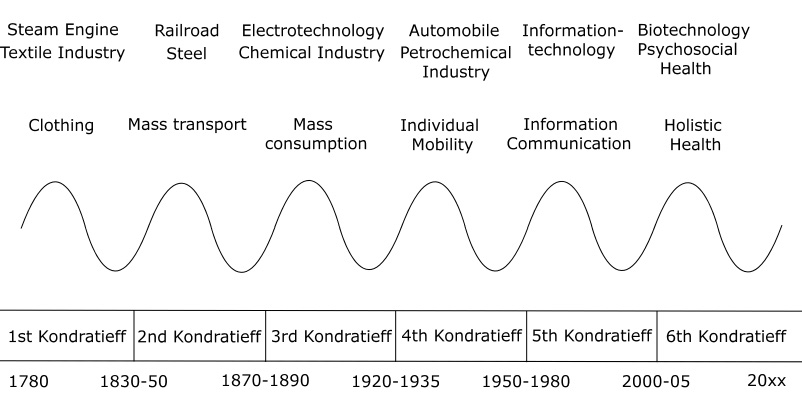 |
| Credit: The six long waves of economic development - sociostudies.org |
The Role of Technology in K-Waves
One of the most fascinating aspects of the Kondratieff Wave is its strong connection to technological innovation.
Each long wave is often driven by a transformational technology that reshapes the economy and society:
- Industrial Revolution – Steam power and textiles
- Railways and Steel – Mass transportation and infrastructure
- Electricity and Automobiles – Modern manufacturing and urbanization
- Computers and the Internet – Digital economy and globalization
- Artificial Intelligence & Automation – Data-driven productivity and new business models
These technologies initially spark rapid growth, but over time, their benefits mature, competition increases, debt builds up, and the economy eventually enters a crisis phase — clearing the way for the next innovation cycle.
Why the Kondratieff Wave Is Similar to the Benner Cycle
For readers familiar with the Benner Cycle, the Kondratieff Wave will feel surprisingly intuitive.
Both theories share key ideas:
- Economic patterns repeat over time
- Markets move in waves, not chaos
- Crises are part of a natural cycle, not anomalies
- Understanding cycles helps identify long-term opportunities
While the Benner Cycle focuses more on historical market timing, the Kondratieff Wave takes a broader view — combining economics, technology, and social change into one long-term framework.
In short, both suggest that history doesn’t repeat exactly, but it often rhymes.
Where Are We Now in the Kondratieff Wave?
This is the question many investors and economists are asking:
“Which phase of the Kondratieff Wave is the global economy currently in?”
Opinions vary, but many believe we are transitioning from a late-stage digital wave into a crisis or restructuring phase, marked by:
- High global debt
- Financial market volatility
- Geopolitical tension
- Technological disruption (AI replacing traditional jobs)
At the same time, emerging technologies such as AI, renewable energy, and biotechnology may already be laying the foundation for the next long-term expansion.
Historically, the most uncomfortable periods — recessions and crises — have also been the moments when future economic leaders were born.
Why the Kondratieff Wave Matters for Long-Term Investors
The Kondratieff Wave is not a short-term trading tool. Instead, it is best used for:
- Big-picture thinking
- Understanding why markets feel euphoric or fearful
- Identifying long-term structural trends
- Preparing emotionally for inevitable downturns
Rather than asking “What will the market do this year?”, the K-Wave encourages a deeper question:
“What kind of economic era are we entering?”
Final Thoughts
The Kondratieff Wave reminds us that economic cycles are deeply connected to human behavior, innovation, and time. Just like the Benner Cycle, it offers a framework to see beyond daily headlines and understand the rhythm of capitalism itself.
For readers who enjoy cycle-based thinking, the K-Wave is not about predicting exact dates — it’s about seeing patterns, managing expectations, and recognizing that every crisis also carries the seeds of the next opportunity.
You may like
Read more:


: Understanding the Long-Term Economic Cycle)