
Understanding School Holiday Zones in France

Introduction
One thing I really like about living in France is how thoughtfully the country manages everyday life, even something as simple as school holidays.
At first, I was a bit confused when I noticed that school holidays in different parts of France do not start at the same time. Some regions begin their winter break earlier, while others continue working for another week or two. Later, I discovered that this is actually a smart system designed to manage travel and reduce congestion across the country.
What I personally appreciate about this idea is that it allows some people to travel and enjoy their holidays while others are still working, instead of everyone leaving at the same time. This helps prevent overcrowded roads, packed trains, and fully booked hotels all at once. It also supports the tourism industry by spreading visitors across several weeks rather than just a few days.
This system is known as the French school holiday zone system, and it divides the country into three zones: Zone A, Zone B, and Zone C.
In this article, we will explore what these zones are, which areas belong to each zone, and why France uses this system.
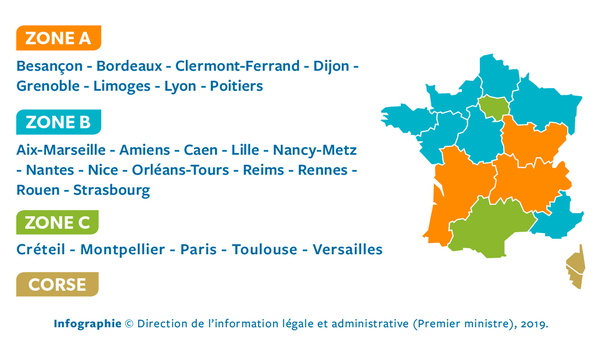 |
| ©Direction de l’information légale adminstrative |
What Are School Holiday Zones in France?
In France, most public holidays are the same nationwide. However, school holidays (Vacances scolaires) are divided into three zones:
- Zone A
- Zone B
- Zone C
These zones have staggered holiday schedules, typically differing by one to two weeks. This system mainly applies to major school breaks such as:
- Winter holidays
- Spring holidays
The goal is to distribute travel demand more evenly across the country.
Zone A
Zone A includes several academic districts located mainly in the eastern and southwestern parts of France. Major cities in this zone include:
- Besançon
- Bordeaux
- Clermont-Ferrand
- Dijon
- Grenoble
- Lyon
- Limoges
- Poitiers
Key regions associated with Zone A include:
- Auvergne-Rhône-Alpes
- Nouvelle-Aquitaine
- Bourgogne-Franche-Comté
Zone B
Zone B covers areas in the north, west, and parts of southern France. Major cities include:
- Aix-Marseille
- Amiens
- Lille
- Nancy-Metz
- Nantes
- Nice
- Orléans-Tours
- Reims
- Rennes
- Strasbourg
Important regions in Zone B include:
- Brittany
- Pays de la Loire
- Grand Est
- Hauts-de-France
- Provence-Alpes-Côte d'Azur
For example, the region of Brittany (Bretagne), where the city of Rennes is located, belongs to Zone B.
Zone C
Zone C includes the Paris region and some southern areas. Major cities include:
- Créteil
- Montpellier
- Paris
- Toulouse
- Versailles
The main regions in Zone C include:
- Île-de-France
- Occitanie
Why Does France Divide School Holidays Into Zones?
This system was created to manage the travel patterns of millions of residents. The main reasons include:
1. Reducing overcrowding at tourist destinations: If all schools closed at the same time, popular destinations such as ski resorts, beaches, and major tourist cities would become extremely crowded.
2. Supporting the tourism economy: Hotels, restaurants, and tourism businesses benefit from a steady flow of visitors over several weeks, rather than experiencing a single intense peak period.
3. Minimising traffic congestion: France has historically experienced massive traffic jams during national holiday departures. Staggering school holidays helps reduce nationwide congestion.
Final Thoughts
The Zone A, Zone B, and Zone C system is a practical way for France to manage school holidays while balancing tourism, travel demand, and economic activity across the country.
If you are planning to travel within France, understanding these zones can help you choose the best time to visit popular destinations and avoid peak travel periods.

