
The French Revolutionary and Napoleonic Wars (1792–1815)

Introduction: The French Revolutionary and Napoleonic Wars
When: 1792–1815 (23 years)
Combatants: Great Britain and its allies vs France and its allies
Reasons: Revolutionary expansion and French imperial ambitions following the French Revolution
Other names: The War of the First/Second/Third/Fourth/Fifth Coalition; the Hundred Days
Key battles and places: Guadeloupe (1815), Saint Lucia, Grenada, Saint Vincent
Important events: Execution of Louis XVI, the Haitian Revolution, and the rise of Napoleon Bonaparte
Outcome: The wars ended after Napoleon’s defeat at the Battle of Waterloo in 1815, reshaping European power and influencing global politics.
The French Revolutionary and Napoleonic Wars were a series of global conflicts that reshaped Europe and its colonies between 1792 and 1815. These wars were fought mainly between France and its allies against Great Britain and several European coalitions, including powers such as Austria, Prussia, and Russia.
The conflict began during the upheaval of the French Revolution and eventually expanded into the Napoleonic Wars, led by Napoleon Bonaparte. These wars were also known by several other names, including the Wars of the First, Second, Third, Fourth, and Fifth Coalitions and the dramatic final phase known as the Hundred Days.

Why the Wars Began
The immediate cause of the conflict was the political crisis created by the French Revolution. In 1793, the execution of the French king, Louis XVI, shocked monarchies across Europe. Many rulers feared that revolutionary ideas such as liberty, equality, and fraternity could spread to their own countries.
France, driven by revolutionary enthusiasm and later by imperial ambitions, soon found itself at war with multiple European powers. These alliances formed a series of coalitions against France, creating nearly continuous warfare for more than two decades.
 |
| The execution of King Louis XVI of France at the age of 38. Credit: worldhistory.org |
Internal Battles: Royalist Uprisings and Coastal Defense
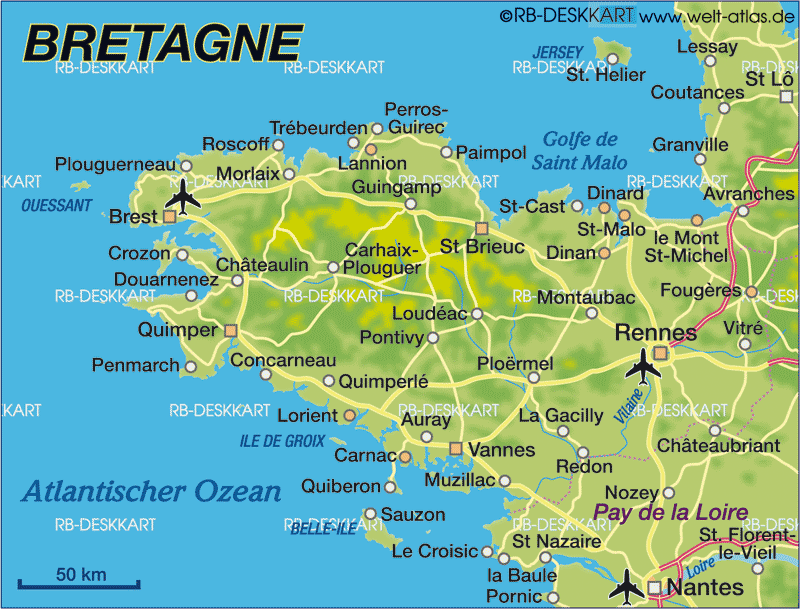
Even though Brittany did not host famous Napoleonic battles, the region was important because of:
- Royalist uprisings like the Chouannerie
- British naval blockades
- The failed Quiberon royalist invasion
- Strategic naval ports such as Brest
One of the most important events in Brittany during the revolution was the Chouannerie, a series of royalist rebellions between 1793 and 1800.
- Many people in rural Brittany supported the monarchy and the Catholic Church.
- They opposed the revolutionary government in Paris.
- Royalist guerrilla fighters known as Chouans attacked republican troops and officials.
Key leaders included:
- Georges Cadoudal
- Jean Cottereau
These uprisings were strongest in western France, especially in areas near Vannes, Rennes, and Saint-Malo.
The fighting was more like guerrilla warfare rather than large battles.
 |
| The Chouannerie Royalist. Credit: i.pinimg.com |
🔵 2. British Naval Threat Along the Breton Coast
Because Brittany has a long coastline on the Atlantic Ocean, it was strategically important during the wars between France and Great Britain.
Important ports such as:
- Brest
- Lorient
- Saint-Malo
were major naval bases.
The British Royal Navy blockaded these ports for long periods to prevent the French fleet from sailing.
This blockade limited France’s naval operations during the Napoleonic Wars.
🔵 3. Failed Royalist Landing at Quiberon
Another important event near Brittany was the Quiberon Expedition in 1795.
- Royalist French forces supported by British troops landed near Quiberon.
- Their goal was to overthrow the revolutionary government.
However, the expedition failed, and the republican army defeated the royalists.
This event strengthened the revolutionary government’s control over the region.
 |
| Credit: welt-atlas.de |
🔵 4. Naval Power and Shipbuilding
Brittany was also important for shipbuilding and naval logistics during the wars.
For example:
- The port of Brest was one of France’s most important naval bases.
- Many French warships and sailors came from this region.
War Spreads Beyond Europe
Although the wars are often associated with battles in Europe, they also spread across the globe, particularly to the Caribbean, where colonial possessions were strategically and economically important.
Several islands changed hands during the conflict, including:
- Guadeloupe
- Saint Lucia
- Grenada
- Saint Vincent
In many of these territories, local populations played an important role in the fighting. Some inhabitants of French colonies remained loyal to the monarchy and supported British forces hoping to restore royal rule.

 |
| Credit: mapsontheweb.zoom-maps.com |
Revolutionary Ideas and Caribbean Revolts
The revolutionary ideals of liberty, equality, and fraternity had a major impact on Caribbean societies. At the time, many islands relied on plantation economies that depended on enslaved labour. Revolutionary ideas encouraged uprisings among both free and enslaved Black populations.
The most dramatic example was the Haitian Revolution, which began in 1791 in the French colony of Saint-Domingue (modern-day Haiti).
During the conflict, Britain intervened in the colony in 1793 after requests from local inhabitants. However, the British campaign was disastrous. Out of more than 20,000 troops, around 13,000 died, mainly from disease.
The revolution was ultimately led by the famous revolutionary leader Toussaint Louverture. In 1804, the revolutionaries defeated French forces and established Haiti as the first independent Black republic in the world.
British Campaigns in the Caribbean
British military operations in the Caribbean were led by experienced commanders such as Charles Grey, 1st Earl Grey and naval commander John Jervis, 1st Earl of St Vincent.
In 1794, British forces successfully captured several French colonies. Their campaign included major operations in:
- Martinique
- Saint Lucia
- Guadeloupe
These victories were achieved through coordinated attacks, amphibious landings, and effective battlefield tactics developed during earlier wars such as the American Revolution.
However, maintaining control of the islands proved difficult. Tropical diseases, limited reinforcements, and French counterattacks weakened British positions. In some cases, France was able to recapture its territories.
Uprisings and Regional Conflicts
The war also sparked local uprisings across the Caribbean. One notable rebellion occurred in 1795 on Grenada, led by a mixed-race plantation owner named Julien Fédon. Supported by French Republicans, the rebels captured large parts of the island and even took the British governor prisoner.
At the same time, conflicts spread to other islands such as Saint Vincent, where the Carib population resisted British rule with French support.
British commanders struggled to control multiple uprisings while dealing with limited troops and widespread disease.
New Campaigns and Expanding War
Later campaigns were led by generals such as Ralph Abercromby, who arrived in the Caribbean in 1796 with new forces. His objectives included:
- Recapturing French colonies
- Suppressing local uprisings
- Securing Dutch colonies in South America
Abercromby successfully captured several territories, including the Spanish island of Trinidad, which surrendered to British forces with minimal resistance in 1797.
The Peace of Amiens and Renewed War
In 1802, the conflict temporarily paused with the signing of the Peace of Amiens between Britain and France. Many Caribbean territories were returned to their previous colonial owners, although Britain retained control of Trinidad.
The peace was short-lived. War resumed in 1803, marking the beginning of the Napoleonic Wars, as Napoleon had by then become the leader of France.
Final Campaigns in the Caribbean
During the later phase of the war, Britain continued its campaign against French colonies. Major operations included the capture of:
- Martinique in 1809
- Guadeloupe in 1810
These victories effectively ended large-scale fighting in the Caribbean.
However, conflict briefly returned in 1815 during the Hundred Days when Napoleon escaped from exile on Elba and regained power in France.
Supporters of Napoleon in Guadeloupe declared their loyalty to him, prompting British forces under James Leith to invade the island in August 1815. After several days of fighting, the French surrendered, bringing the Caribbean phase of the wars to an end.
The End of the Wars
The final defeat of Napoleon Bonaparte occurred in 1815 at the Battle of Waterloo in present-day Belgium. After this defeat, Napoleon was exiled to the remote island of Saint Helena, where he died in 1821.

Legacy of the Wars
The French Revolutionary and Napoleonic Wars had enormous global consequences:
- The spread of revolutionary ideas about liberty and citizenship
- Major changes in European and colonial political systems
- The rise of nationalism across many regions
- The independence of Haiti, the first Black republic
These wars not only reshaped Europe but also transformed colonial societies and influenced political developments around the world for generations.
Final Thoughts
The French Revolutionary and Napoleonic Wars were far more than European conflicts. They were global struggles involving empires, colonies, and revolutionary ideas. From the battlefields of Europe to the plantations of the Caribbean, these wars changed the course of history and left a legacy that still shapes the modern world.
You may like
Read more:
💙 The Cockade: A Small Ribbon with a Big History in French Culture
.png)


)